http://douthat.blogs.nytimes.com/2012/07/16/what-is-liberal-christianity/
If all publicity is good publicity Ross Douthat has done a service to the Episcopal Church by announcing its forthcoming collapse in his NYTimes column and blog. His thesis is the standard, discredited explanation from Dean Kelly's 1972 book Why the Conservative Churches are Growing
By the same token I suppose liberals are doing good simply by responding--even though their defenses of the faith range from unconvincing to offensive:
Unconvincing: "My wonderful inclusive parish is vibrant and growing." (Congrats to your vibrant, inclusive parish but, sorry, the stats overall for the Episcopal Church, and all other mainline churches are terrible)
Offensive: "People are leaving because they're a bunch of ignorant, homophobic bigots who prefer to check their brains at the door: our church is too good for them. And we have a low birth rate because our people are conscientiously choosing to be child-free in order to save the environment." (No comment)
For heaven's sake, isn't the problem obvious? People look to churches for religion--not endless politically correct harangues and volunteer work. The problem isn't that liberal churches have become too liberal socially and politically, or that they've rejected "traditional morality"--the problem is that they've jettisoned traditional metaphysics and liturgy. Currently slightly more than half of Americans support gay marriage: the Episcopal Church is hardly showing "prophetic witness" in this regard. If some 51% of Americans agree with the Episcopal Church's sexual ethics, how come the Episcopal Church now represents just under 1% of the population?
The problem isn't that the Episcopal Church is too ethically and socially liberal for most people's tastes. The Church is collapsing because of lack of faith--because the leadership has rejected supernaturalism, believes that theism is completely out of the ballpark for educated people (as Spong declared in his 12 Theses) and regards religion as uninteresting and basically a waste of time. Given these assumptions it's hardly worth making the effort to get more people into the pews (as long as the endowment holds out). Anyway, they should be out in the World, doing social service and political activism--not wasting their time in church.
Why, why couldn't the church have ditched "traditional morality" but kept the metaphysics and liturgy? Isn't this what the whole "spiritual-but-not-religious" movement is about? People want the the woo-woo, the ceremonies and paraphernalia, without the Biblical literalism, puritanism and social conservatism they associate with Christianity. Here is a market niche the Episcopal Church was ideally situated to capture: fancy churches, good music, elaborate rituals, and mysticism without "traditional morality" or Biblical literalism. But it didn't. It adopted a stinking new Prayer Book, contemporary English, the Peace and other detestable garbage that expunged every bit of the numinous from the liturgy.
And ironically, that was just more puritanism, more moralism. Liberals condemned conservatives for puritanitanical restrictions on sexual activity, but liberals were even more puritanical about fantasy, beauty and "escapism." Don't you dare enjoy church--you're here to be edified, to be pushed to go out into the World and work for Justice, Freedom and Peace. Of course if we had a moral motivation drug that we could put in the water supply to make everyone go out and work for social justice we wouldn't need religion at all! We'd sell off all those wasteful churches--every grain of incense is bread from the mouths of the poor--and spend all that money on Justice, Freedom and Peace.
Showing posts with label religion. Show all posts
Showing posts with label religion. Show all posts
Thursday, August 16, 2012


Friday, December 03, 2010
Why Can't Christianity Be More Like Yoga?
Hindu Group Stirs Debate in Fight for Soul of Yoga - NYTimes.com: "- Sent using Google Toolbar"
Most who do their yoga on the beach or at (my gym) Women's Fitness World may may be shocked to discover that yoga has its roots in Hinduism. People take yoga on their own terms. They buy what they like. They don't think of it as a religion, or as a component of a religion.
Why shouldn't we treat Christianity that way? Most people in fact do: they treat Christianity casually, cherry-pick and buy what they like. The general consensus is that this is a very bad thing, but why?
There is, of course, the Creed. But there are all sorts of doctrines associated with yoga--about chakras, vedas and that kind of thing. Some believe, many think their might be something to it but don't pay much attention, some are just there for the exercise and dismiss it completely. No one is bothered. There are also some Christian enthusiasts who are gung-ho for every article of the Catechism and make strenuous efforts to walk the walk. But there are also many who think their might be something to it but don't pay much attention and some who are just Evensong concert-goers. Why is it ok to be a casual, skeptial yoga practitioner but not a casual, skeptical Christian.
Flap your mouths, waffle around, bluster and blow: there is no answer, no reason why should be somehow wrong, and vicious, to treat Christianity casually, to be a skeptical Christian, and to buy what one likes.
Hindu Group Stirs Debate in Fight for Soul of Yoga - NYTimes.com: "- Sent using Google Toolbar"
[A] group of Indian-Americans has ignited a surprisingly fierce debate in the gentle world of yoga by mounting a campaign to acquaint Westerners with the faith that it says underlies every single yoga style followed in gyms, ashrams and spas: Hinduism. The campaign, labeled “Take Back Yoga,” does not ask yoga devotees to become Hindu, or instructors to teach more about Hinduism. The small but increasingly influential group behind it, the Hindu American Foundation, suggests only that people become more aware of yoga’s debt to the faith’s ancient traditions.Almost everyone I know does yoga. Some are interested in the 'philosophy' behind it; most are just looking for stretching exercises to improve flexibility and general health. Some are devoted, most are casual, and no one thinks that they're under any obligation either to go the whole hog on yoga rather than participate casually, or that they ought to buy the 'philosophy' attached to the practice. Some do; some don't.
Most who do their yoga on the beach or at (my gym) Women's Fitness World may may be shocked to discover that yoga has its roots in Hinduism. People take yoga on their own terms. They buy what they like. They don't think of it as a religion, or as a component of a religion.
Why shouldn't we treat Christianity that way? Most people in fact do: they treat Christianity casually, cherry-pick and buy what they like. The general consensus is that this is a very bad thing, but why?
There is, of course, the Creed. But there are all sorts of doctrines associated with yoga--about chakras, vedas and that kind of thing. Some believe, many think their might be something to it but don't pay much attention, some are just there for the exercise and dismiss it completely. No one is bothered. There are also some Christian enthusiasts who are gung-ho for every article of the Catechism and make strenuous efforts to walk the walk. But there are also many who think their might be something to it but don't pay much attention and some who are just Evensong concert-goers. Why is it ok to be a casual, skeptial yoga practitioner but not a casual, skeptical Christian.
Flap your mouths, waffle around, bluster and blow: there is no answer, no reason why should be somehow wrong, and vicious, to treat Christianity casually, to be a skeptical Christian, and to buy what one likes.
Wednesday, September 15, 2010
Theological Trade-Offs
Just a note to myself for further development.
When it comes to the analysis of religious claims there is a trade-off between content and credibility, universality and practical import. Theological stakeholders want to make the case that religious claims are believable--in particular, that they can and should be believed with a high degree of conviction. They also have a vested interest in establishing that these claims are of universal interest and that they are of serious practical import for the lives of individuals and the social good.
If however they are interpreted in the traditional way, as metaphysical claims about the supernatural, then they do not have these desiderata. All metaphysical claims are controversial: there are good arguments for for a variety of different positions and smart people on every which side. That's philosophy--like history, argument without end. So no one with any sense will hold any metaphysical belief with any high degree of conviction. If religious claims are to be held with the highest degree of conviction then they can't be interpreted as metaphysical claims.
So the strategy of revisionary theologians in the teeth of legitimate skepticism is to reinterpret religious claims so that they can be more readily believed. So, as we were told 40 years ago, "I believe in God" really means "I am committed to an agapistic way of life" or "I affirm Being as gracious." I have no idea what the latter affirmation comes to, but it doesn't seem to commit one to anything controversial--or in fact to anything at all. As for commitment to an agapistic way of life, I suppose this means that I believe that we should try to be nice. I guess I can buy that. In either case, "I believe in God" has been detoxified in the interests of greater credibility, so that religious belief can be taken on by more people and with greater conviction. Indeed, I believe with the highest degree of conviction that people should be nice rather than nasty.
Theological revisionists are also concerned to make the case that religion is of universal interest and great significance. Neither of these things are true of metaphysics--which is of no interest to most people and has no practical import whatsoever. Strange as it seems to me, metaphysics, my specialty area, just doesn't interest most people. It doesn't even interest most philosophers. And one reason why it doesn't interest most people is that it is completely inconsequential. In particular, it doesn't deliver the goods many people expect out of philosophy: answers to questions about how to live the Good Life, profound truths about the human condition, edification and a variety of other things that I find boring or unintelligible but which seem to interest a great many people.
So, in the interests of making religion universally interesting and significant, theological revisionists reinterpret it as some hybrid of ethics, psychology and existentialist "philosophy."
But why bother--unless of course you're a priest whose livelihood and self-importance depends on it. Why not just admit: religious belief is very, very controversial. No reasonable person can believe in God with a high degree of conviction--the best we can do is guess and hope. And why not admit that religion, like metaphysics, is just not of universal, or even wide, interest. It's a special taste, like the taste I have for metaphysics. Some people, like me, just plain enjoy religion: we have fun with the metaphysics (in my case identity puzzles concerning the Trinity doctrine especially), enjoy liturgy and religious art, and are interested in mysticism. Most people however find all this a bore and, in the absence of social pressure, cannot be expected to bother with religion. So let's just say that there's no reason to imagine that everyone should be religious any more than there is to think that everyone should collect stamps or enjoy recreational math puzzles or knit.
This of course suggests that religion is an inconsequential hobby, that people can get on perfectly well without it. And that I believe is the case.
So let's admit it. Instead of reinterpreting religion so that the salt loses its savor, revising and minimizing so that it's no more than a self-help program or do-good project, let us admit that religion, that is metaphysics/liturgy/mysticism is a specialty item that only interests a minority of people and that religious claims, like all metaphysical propositions, are both controversial and inconsequential.
Friday, July 09, 2010
The Religion of Privilege
New Age Religion and Western Culture
Why on earth should we want an alternative to a culture of liberal utilitarianism?
Ironically, in spite of the popular notion that this liberal utilitarianism, wrapped up with the quest for wealth and power, is hierarchical and inegalitarian, it is the New Age alternative that is elitist.
It's no accident that New Age preoccupations are largely restricted to the elite. The rejection of dualism and reductionism, and the mellow 'holism' of the New Age, are a luxuries only the elite can afford. For the rest of us Nature is not benign, and neither is the social world in which we live. Our lives are a fight--against the institutions that constrain us, the individuals in positions of power who impose their will on us, the elites (including New Age devotées) who are contemptuous of us, and Nature itself which thwarts us. The elite, the people whose lives are easy, can afford to be mellow: we can't. Nature is good to them: they can afford to kick back and enjoy. For us, life in the state of Nature is nasty, brutish and short: to get decent lives for ourselves we have to subdue Nature, which thwarts us at every turn.
The elite can afford to shop at Whole Foods. The elite in affluent countries can afford not to have their children vaccinated because they can count on herd immunity. Elite men can do their share of 'parenting' because their work schedules are within their control and because they aren't fagged out after a day of hard manual labor. Elite women can afford to breast feed, make their own baby food and use cloth diapers because they can hire non-elite nannys to do most of the grunt work. Elite couples can afford to garden, compost, and cook from scratch: they have the money and leisure.
Elitism though isn't only, or even primarily, a matter of wealth, power or class. It is a matter of social worth. Even before there were the social institutions that created wealth and class, there was the elitism of personal qualities: there was the elite of the young, strong, beautiful and socially competent. In the State of Nature, the elderly get shoved off to die on ice flows and ugly little toads like me are throwaways.
The whole purpose of the traditional moral rules that New Age elitists regard as irritating, irrational constraints is to promote the interests of the rest of us--the non-elite. These rules constrain people who are better off in order to provide more opportunities for those of us who are worse off. We are of course "dualists" because life for us is adversarial, trapped in bodies we hate, fighting against people who despise and thwart us. The dualistic message of Christianity is for us. It tells us that we are not our bodies and that the social circumstances that put us at a disadvantage are irrelevant: in Christ there is no Greek or Jew, male or female, slave or free.
The New Age sensibility is opposed to both "dualistic" Christianity and "reductionist" science. This should hardly surprising because they're two sides of the same coin. By embracing radical dualism and rejecting quasi-naturalistic deities, Christians made room for science--indeed, for reductionist science: for the mechanical universe. Pagans might conjecture that heavenly bodies were conscious beings, that the sun, moon and stars were gods, but not Christians. The Christian God was strictly transcendent--wholly incorporeal and not identified with the material world or any part of it. For all the trouble Galileo had with the Church, his theory wasn't a serious threat to Christianity and neither was Newton's. The idea that the sun, moon and stars were inert lumps of matter operating according to mechanical principles was one that Christianity could easily accommodate, in a way that astral religion could not, because it was outside of the realm of Christian theology.
Fortunately, Bellah's third alternative, the ''revolutionary' scenario according to which the alternative movement would succeed in renewing society and actually bring in a new age" will not come to pass. Like the 60's faux counterculture, New Age was instantly commercialized and will figure only as a package of status symbols for the elite, busily pursuing the neo-liberal dream of wealth and power.
But it will displace Christianity for the elite, and that's what bothers me: the end of intellectually acceptable religion bearing the great art of our culture. Christianity will shrink to the vulgar, stupid white trash religion of conservative evangelicals--no liturgy, no art. Meanwhile the minority of the elite who don't become completely secular will support this hodgepodge of superstition, sentimentality and bad taste--crystals and essential oils, New Age elevator muzak, middle-aged ladies treading labyrinths, and endless self-help products. Vulgar, ugly, boring, stupid slop.
New Age Religion and Western Culture
[A]ll forms of New Age Holism have in common a rejection of dualism and reductionism...It may be noted that the rejection of dualism, in all its forms, is directed principally against dominant forms of Christianity, while the rejection of reductionism is directed specifically against modern scientific rationalism. Thus New Age holism emerges as a reaction to established Christianity, on the one hand, and to rationalistic ideologies, on the other...[T]he New Age movement is indeed a heir of the 'counterculture' of the 1960s...
In 1976, the sociologist Robert N. Bellah speculated about the future. Concentrating on American culture, he perceived three possible options: a 'liberal' scenario according to which society 'would continue as in the past to devote itself to the accumulation of wealth and power...a 'neo-fundamentalist scenario according to which a complete breakdown of society would be followed by a 'relapse into traditional authoritarianism,' most probably dominated by Right-wing protestantism; and an unlikely but perhaps not impossible 'revolutionary' scenario according to which the alternative movement would succeed in renewing society and actually bring in a new age...The New Age has not arrived, but the alternative movement increasingly shows symptoms of being annexed by liberal utilitarian culture...It may be legitimately doubted whether a New Age movement which has become increasingly subservient to the laws of the marketplace is likely to provide a viable alternative to a culture of liberal utilitarianism.
Why on earth should we want an alternative to a culture of liberal utilitarianism?
Ironically, in spite of the popular notion that this liberal utilitarianism, wrapped up with the quest for wealth and power, is hierarchical and inegalitarian, it is the New Age alternative that is elitist.
It's no accident that New Age preoccupations are largely restricted to the elite. The rejection of dualism and reductionism, and the mellow 'holism' of the New Age, are a luxuries only the elite can afford. For the rest of us Nature is not benign, and neither is the social world in which we live. Our lives are a fight--against the institutions that constrain us, the individuals in positions of power who impose their will on us, the elites (including New Age devotées) who are contemptuous of us, and Nature itself which thwarts us. The elite, the people whose lives are easy, can afford to be mellow: we can't. Nature is good to them: they can afford to kick back and enjoy. For us, life in the state of Nature is nasty, brutish and short: to get decent lives for ourselves we have to subdue Nature, which thwarts us at every turn.
The elite can afford to shop at Whole Foods. The elite in affluent countries can afford not to have their children vaccinated because they can count on herd immunity. Elite men can do their share of 'parenting' because their work schedules are within their control and because they aren't fagged out after a day of hard manual labor. Elite women can afford to breast feed, make their own baby food and use cloth diapers because they can hire non-elite nannys to do most of the grunt work. Elite couples can afford to garden, compost, and cook from scratch: they have the money and leisure.
Elitism though isn't only, or even primarily, a matter of wealth, power or class. It is a matter of social worth. Even before there were the social institutions that created wealth and class, there was the elitism of personal qualities: there was the elite of the young, strong, beautiful and socially competent. In the State of Nature, the elderly get shoved off to die on ice flows and ugly little toads like me are throwaways.
The whole purpose of the traditional moral rules that New Age elitists regard as irritating, irrational constraints is to promote the interests of the rest of us--the non-elite. These rules constrain people who are better off in order to provide more opportunities for those of us who are worse off. We are of course "dualists" because life for us is adversarial, trapped in bodies we hate, fighting against people who despise and thwart us. The dualistic message of Christianity is for us. It tells us that we are not our bodies and that the social circumstances that put us at a disadvantage are irrelevant: in Christ there is no Greek or Jew, male or female, slave or free.
The New Age sensibility is opposed to both "dualistic" Christianity and "reductionist" science. This should hardly surprising because they're two sides of the same coin. By embracing radical dualism and rejecting quasi-naturalistic deities, Christians made room for science--indeed, for reductionist science: for the mechanical universe. Pagans might conjecture that heavenly bodies were conscious beings, that the sun, moon and stars were gods, but not Christians. The Christian God was strictly transcendent--wholly incorporeal and not identified with the material world or any part of it. For all the trouble Galileo had with the Church, his theory wasn't a serious threat to Christianity and neither was Newton's. The idea that the sun, moon and stars were inert lumps of matter operating according to mechanical principles was one that Christianity could easily accommodate, in a way that astral religion could not, because it was outside of the realm of Christian theology.
Fortunately, Bellah's third alternative, the ''revolutionary' scenario according to which the alternative movement would succeed in renewing society and actually bring in a new age" will not come to pass. Like the 60's faux counterculture, New Age was instantly commercialized and will figure only as a package of status symbols for the elite, busily pursuing the neo-liberal dream of wealth and power.
But it will displace Christianity for the elite, and that's what bothers me: the end of intellectually acceptable religion bearing the great art of our culture. Christianity will shrink to the vulgar, stupid white trash religion of conservative evangelicals--no liturgy, no art. Meanwhile the minority of the elite who don't become completely secular will support this hodgepodge of superstition, sentimentality and bad taste--crystals and essential oils, New Age elevator muzak, middle-aged ladies treading labyrinths, and endless self-help products. Vulgar, ugly, boring, stupid slop.
Tuesday, May 25, 2010


Death by Gentrification
Some Harlem Churches in Fight for Survival - NYTimes.com
Ministers from churches across Harlem said they had yet to penetrate the walls of the high-price condominiums and the million-dollar refurbished brownstones that now dominate the neighborhood. Some, in truth, expressed little desire to do so. Others said they saw the gentrification of Harlem as an opportunity, but one as yet unrealized.
The gentry don't go to church. The New Atheists of course have an easy explanation: the gentry are too smart and educated to buy superstitious nonsense.
But the gentry buy all manner of other superstitious nonsense--food fetishes, conspiracy theories, alternative medicine and a variety doctrines that are not only empirically falsified but dangerous. It isn't, for example, the churchgoing masses who have for over a decade endangered their own children and the general public by refusing to have their kids vaccinated.
There is some good news: the doctor who invented the myth that MMR vaccine caused autism has now been defrocked--or whatever it is they do to doctors who misbehave in the most serious way. The story is remarkable:
In January, after the longest investigation in its history, the council found several instances of what it said was unprofessional conduct by Dr. Wakefield. It cited his taking blood samples for his study from children at his son’s birthday party; he paid each child £5, about $7.20 today, and joked about it later. It also noted that part of the costs of Dr. Wakefield’s research was paid by lawyers for parents seeking to sue vaccine makers for damages....The disciplinary tribunal’s action came after more than a decade of controversy over the links Dr. Wakefield and associates in Britain, as well as supporters among parents of some autistic children in Britain and the United States, have made between autism and a commonly used vaccine for measles, mumps and rubella. The suggestion of a link caused use of the vaccine in Britain and elsewhere in the world to plummet, a development that critics of Dr. Wakefield said contributed to a sharp rise in measles cases in countries where the vaccine was in use...
The council said he had shown “a callous disregard” for the suffering of children involved in his research. The ruling banning him from practicing medicine on Tuesday was a sequel to the January finding...In all, Dr. Wakefield was found guilty of more than 30 charges.“The panel concluded,” Dr. Kumar said, “that it is the only sanction that is appropriate to protect patients and is in the wider public interest, including the maintenance of public trust and confidence in the profession.” He said the sanction was “proportionate to the serious and wide-ranging findings made against him...
Dr. Wakefield resigned in February from his position as a staff researcher at Thoughtful House, an alternative medicine clinic in Austin, Tex...A 2007 annual report for the clinic has a picture of Dr. Wakefield looking into microscope with a caption that reads: “Where would we be without Dr. Wakefield and your entire team? Thank you for your courageous efforts in swimming against the tide. Without you we would still be hearing, ‘There is nothing we can do.’ Because of you we know the hope is great and the progress is attainable.
It wasn't the huddled masses who followed (ex-)Dr. Wakefield or financed his operation.
Theological revisionism, reductionist programs intended to make Christianity acceptable to what used to be called Modern Secular Man, are a complete failure because the target audience is as grossly superstitious as a bunch of medieval Western European peasants or Hottentots.
So here's the grand question: how can the Church exploit the superstition and stupidity of the Upper Middle Class to win them back?
Saturday, December 12, 2009

Hellinistic Syncretism Redux!
http://pewforum.org/docs/?DocID=490
A new poll by the Pew Research Center's Forum on Religion & Public Life finds that large numbers of Americans engage in multiple religious practices, mixing elements of diverse traditions. Many say they attend worship services of more than one faith or denomination -- even when they are not traveling or going to special events like weddings and funerals. Many also blend Christianity with Eastern or New Age beliefs such as reincarnation, astrology and the presence of spiritual energy in physical objects.
I'm all for it. This, I believe, is the shape religion should take and the direction in which ecumenism should have gone. I cannot fathom why it should matter whether Christian churches agree on fundamental theological claims, much less whether they achieve some sort of liturgical uniformity. What matters is that individuals are welcome to participate in any cult the please whenever they choose, no questions asked.
Churches are now collapsing under their weight of their own arrogance--imagining that they have wisdom to teach, that they embody "worldviews," that they are in a position to teach us how to live. Priests imagine that they're able to exercise intellectual and moral leadership. The sheer arrogance is breathtaking. These jerks want to be important, when they are, and should be, no more than trained monkeys doing pujas.
The pity is that the high cults are dying, as the cults of the city gods did during the Hellenistic period, and being replaced by vulgar, superstitious, boring crap. We know what the denoument was then: Constantine and the triumph of Christianity, gobbling up both high and low paganism--the Neoplatonism of the elite assimilated and the superstition of the vulgar sucked into the cult of the saints. I doubt that this will happen again. It was an historical accident that an emperor took up a cult and promoted it.
It seems a shame. Almost two thousand years of an historical tradition, the development of theology and art--so much of the good stuff of our culture trashed and replaced by the vulgar shopping mall religiousity of the megachurches, commercialized New Age products, and bits and pieces of Eastern Religions.
I don't care if people do yoga or dance naked around maypoles or play at Wicca. I just want my cult to survive so that I can enjoy it.
Sunday, September 13, 2009

The Church of the Divine Slacker
The Church of the Slacker God | Machines Like Us
[W]e should really think of 'accommodationists' as 'worshippers in The Church of the Slacker God.' But this raises the question of why intellectuals like Wright and Baber so desperately want to belong to such a church, which frankly does not seem to offer much to its parishioners. After all, it rules out answers to prayers, miracles, heaven, and all the other goodies that entice believers to join the more mainstream churches, even though those goodies never actually materialize. How much mileage can you get out of the mere contemplation of 'ultimate beauty, power, and glory', as Baber suggests...Why do religious intellectuals like Baber and Wright feel the need to find reasons to believe in the existence of such a slacker god?...Why is it that even the Slacker God is so appealing to people like Wright and Baber? Perhaps they think that even though this entity has never done anything apart from creating the universe and its laws right at the beginning, it has the potential to do something, and they find that thought somehow comforting.
The New Atheists are an irritating lot for at least 3 reasons:
(1) First, while there is nothing to say about atheism, the New Atheists just keep talking...and blogging, and commenting, and writing books, and talking and talking and talking.
There's nothing to say about atheism for the same reason that there's nothing to say about non-stamp-collecting: it's simply the denial of a thesis and non-participation in a practice. There is plenty to say about stamp collecting, none of which interests me, and even more to say about religious belief and practice: one can discuss theology, church history, liturgy, ecclesiastical politics, and so on ad nauseum. But there's nothing of interest to say about atheism: all one can say is that atheists don't believe the theological claims and don't engage in religious practice, which is pretty obvious and thoroughly uninteresting.
Consequently, the only thing atheists qua atheists have to talk about is why they aren't theists: why theological claims are implausible and why the practice of religion is silly, superstitious, pointless or positively dangerous. But we've heard it all. Hume said it, and said it well. Russell said it and popularizers like Mencken and Sinclair Lewis packaged it for mass consumption. The New Atheist project of saying it over and over again seems distinctly pointless--and thoroughly boring.
I'm not suggesting that the New Atheists' criticism of religious belief and practice is impolite or strident or disparaging of religion, which ought to be respected. I'm fine with rudeness and stridency, in which I often engage myself, and see no reason why religion should be respected. I just don't see why atheists should engage in the critique of religious belief and practice--any more than non-stamp collectors should spend their time and energy going on about how boring and pointless stamp collecting is. Certainly, when religious belief is under consideration, in philosophy of religion classes or public debates, that critique needs to be considered--and represented in it's most powerful and compelling form. I just don't see any reason why, apart from this, atheists should endlessly rehearse anti-theistic arguments, or affiliate with atheist organizations or send their kids to atheist summer camps any more than non-stamp-collectors should make a fuss about the folly of stamp collecting, or join non-stamp-collector organizations or send their kids to non-stamp-collector camps.
(2) New Atheist bloggers and commentators are, for the most part (though not universally) just bloody awful.
Not everybody of course. There are interesting blogs and intelligent commentators. But enter this arena and in most cases it is impossible to get anywhere because of the defensiveness and clubbiness, informal fallacies and meta-talk. Enter into a discussion with a comment about the New Atheists and immediately you will be challenged for calling them "the New Atheists"--there is apparently a back story, which I don't know, and the phrase is taken to be derogatory. Before cutting to the chase you have to explain that you don't mean "New Atheists" in any derogatory sense and explain what you do mean. By the time the discussion of nomenclature is finished you are too tired and frustrated to go on and have forgotten the original point.
The defensiveness and hostility are incomprehensible. I've known a few people who were brought up in oppressive, conservative religious homes--chiefly embittered ex-Catholics--who are still angry, resentful, hostile to religion, and defensive. I get it. And I can see how secular people living in strongly religious, social conservative cultures might be equally hostile and defensive. But very few people now are in these circumstances.
I eavesdrop on the discussions and hear people who have not had the old time religion banged into them as kids and who live in subcultures where secularism is the norm expressing or, as I believe, feigning the same defensiveness and hostility. I don't get it. One way or the other though, it is frustrating and, I'm beginning to believe, pointless to engage in discussion.
I got into one of these frustrating discussions on one blog at which a commentator referred to the virtual space of the discussion as "our atheist living room." OK, I get it: there are lots of ostensibly public spaces devoted to discussion and debate on the internet that are in fact semi-private clubs. I've blundered into these places quite often, entered into the discussion, and eventually finally given up (or been kicked out) when I realized that the purpose was "community" and mutual support rather than discussion or debate. As far as I can see most New Atheist blogs are de facto atheist living rooms and there are simply few venues for serious discussion.
(3) New Atheists don't get religion, don't get that they don't get religion, and are unwilling to entertain the possibility that there is anything to get.
How much mileage can you get out of the mere contemplation of 'ultimate beauty, power, and glory', as Baber suggests
This is like asking how much mileage you can get out of great sex. How could the Greeks and Trojans have fought that epic war over Helen? Or like asking how much mileage you can get out of love of country or the desire to create a better, fairer society or relieve suffering or achieve fame and fortune or make significant advances in the sciences or save the ecosystem or any of the other things which various people regard as of ultimate importance. I myself don't get the importance of great sex, love of country, the desire to create a better society or relieve suffering, the desire for achievement or a whole host of other goals that others regard as important. But I get that they regard these things as important, and I'm even curious what it would feel like to regard these things as important. I don't think that they can't possibly really have these interests and goals, or believe that when they say they have these aims they must be disingenuous or self-deceiving and really be after something else.
Most atheists, new and old, and most religious believers don't get that there is something to get about the desire for religious experience and seem to think that the motive for religious belief and practice must really be something else.
Why is it that even the Slacker God is so appealing to people like Wright and Baber? Perhaps they think that even though this entity has never done anything apart from creating the universe and its laws right at the beginning, it has the potential to do something, and they find that thought somehow comforting.
I can only speak for myself, but I have no interest in the potential of God to "do something" or in some sort of "comfort." I'm perfectly capable of taking care of myself, believe that science explains all there is to explain about how the material world works and that technology is all we need to solve all our practical problems. I am not looking for "comfort."
For me, aesthetics is the whole enchilada and religious experience is the limit of aesthetic experience. The very phrase, "mere contemplation of 'ultimate beauty, power, and glory'" is bizarre: what could be more important or less "mere"? This is like saying "mere fame," "mere money," "mere achievement" or "mere orgasm." Give us some credit. I can't empathize in my gut with people who want to "make a difference" to the world or help people. I just haven't got that in me. But there are clearly lots of people who do. We have lots of kids at my place who enter the "Teach for America" program: they want to "make a difference" and to help. This is opaque to me, but I can recognize that impulse, applaud it, and see that it isn't "really" something else even though it's not something that I myself can feel.
My "ultimate concern" is ecstasy--that slam-bang aesthetic experience in this world and the next: as I understand it, the vision of God. And I'm fascinated by the stuff of religion, not only because it provides the props that facilitate religious/aesthetic experience but because I find it fascinating in and of itself. I just plain like religion for its own sake. Most people don't understand my taste for religion any more than I understand the urge to collect stamps. I do however recognize that some people really like to collect stamps and that their interest in stamp collecting isn't "really" an interest in something else. I dearly wish that others would recognize that my interest in religion and the interest of others who share my tastes, is not "really" something else.
Religion is a minority taste. There's no more reason why most people should be interested in religion than there is reason for people to be interested in stamp collecting. Of course I'd like it personally if more people were interested in religion so that I would be in a comfortable majority rather than a beleagured minority and, more importantly, so that there would be more resources to maintain the religious infrastructure--the church buildings and services--I need to crank up religious experience. But if there is one thing I do NOT believe is that the slacker God in which I do believe cares whether we believe in him or not.
Wednesday, September 09, 2009
Taming Religion
Tony Blair's justification of faith | Andrew Brown | Comment is free | guardian.co.uk:
"Faith is not going to disappear", he said: 'We have this view in Europe that once peope get a bit more sensible, a bit more rational, faith will go out of the window. That's not the way the world works.'..the one thing he did not say or claim, even by implication, was that faith was harmless. It seemed to me that he thinks of it as thoroughly dangerous – which of course it is – but that is what makes it so necessary to tame, and such an interesting challenge for any politician. "If people can't find a way of taking their religious faith into co-existence with others, we're in for a really dangerous time."
When I was an undergraduate my fantasy was the Middle Ages, in particular, what I thought of as "Chaucer's Merry England." Here was a world, at least as Chaucer represented it, where there was pageantry and color, sex, drunkenness and jollity, and lots of religion--which no one took very seriously.
This of course is what the Society for Creative Anachronism calls "the Middle Ages as they should have been" and most certainly were not. But it provides an agenda for taming religion.
What should religion be? That depends on what you think religion is. Nowadays people seem to have high-falutin' notions of what it is that are quite detached from what most religious folk historically would have imagined. They claim it has to do with the Big Questions. According to one of my colleagues who does Freud, religion is a "palliative" in the face of our recognition that the universe is without purpose and that our lives are "meaningless."
I'm not sure in what sense our lives could have "meaning" or what their being "meaningless" comes to but I agree that the universe is without purpose. I'm just not bothered by it, and don't see why anyone should be bothered. I don't see the problem.
Most people as far as I can see aren't bothered by it either and in any case historically most have not thought of these non-issues as the stuff of religion. For the folk, including me, religion is cultic practice and belief in the supernatural. That's the core. In addition religion promotes moral decency--honesty, kindness, diligence and a sort of generic uprightness.
That seems pretty tame to me. To be a religious person is to believe in the supernatural--to believe that there is a God, or gods, or something or other beyond the material world, which may or may not intervene in human affairs but generally does not interfere--and to engage in various religious ceremonies, traditions and practices. What's the problem?
In the US for decades advocates of separation of church and state have fought to keep religion out of the public square--to get prayer out of the public schools, Christmas creches out of public parks, and hilltop crosses off of public land. The New Atheists have joined the crusade. The idea I suppose is that these innocuous symbols and practices are a gateway to the harder stuff: oppressive puritanism, theocracy and superstition, inquisitions and crusades.
It is an empirical question whether suppressing the innocuous trappings of religiousity would make the world a better place. The Beatles, imagining there was no Heaven, seem to have thought so but I rather doubt it. People enjoy religiousity and believe that it promotes moral decency. When crusading secularists work to take it away, they get their backs up--as well they should.
Religious folk have their backs to the wall. In the US the religious white working class is a shrinking minority. They're scared and angry because they believe that their way of life is under attack and that chaos is breaking in. What would satisfy them? Do they really want nothing less than the whole religious right agenda--including "creationism" in the public schools, the suppression of gays and the institution of a whole range of puritanical constraints?
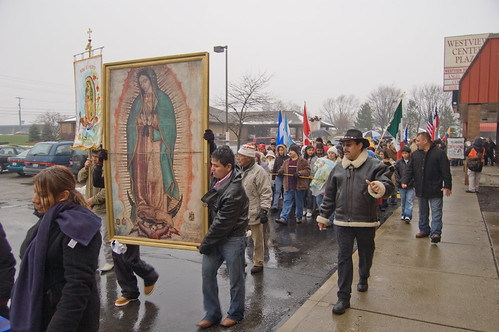
I really doubt it. I think they would be quite happy with displays public religion--creches in the park, ten commandments in front of courthouses, prayer in schools and invocations by clergy at public ceremonies--and the promotion of generic moral decency along the lines of the Girl Scout code. And there is nothing wrong with that. I'd like it myself--along with processions in the streets and other high church fun.
So that seems to me the way to tame religion. Maximize innocuous religiousity.
It's an empirical question whether this would work but it's worth trying. As a thought experiment at least, imagine that there were processions in the streets and prayer in the public schools, that high school athletes huddled in the field to invoke Jesus' support for their team and in time of drought there were public prayers for rain. Imagine that religiousity was pervasive, that the events of the liturgical year were publicly celebrated with public Christmas festivities, passion plays, and other ceremonies in due season.
If we had all that stuff, would anyone care about gay marriage, evolution, stem-cell research or any of these symbolic issues? Call me naive or call me cynical: I doubt it.
Monday, August 31, 2009

On Alpha
Nicky Gumbel interview transcript | Adam Rutherford | Comment is free | guardian.co.uk
We've got something that works in practice, and we're trying to work out how we can make it work in theory. So, why is it? I think there are a number of things about it. I think it's a low key, relaxed, unthreatening, non-confrontational way for people to explore pretty big questions. I think a lot of people do have questions about life, 'What's the purpose of my life?', 'What's the meaning of my life?', 'Why am I here?' … It's hard to find a place where you can discuss those issues. You can't go down to the pub and say, 'What do you think the meaning of life is?' It's hard at a football match to discuss those kinds of issues. But actually, most people have those questions, somewhere in the back of their minds. And if you can find a place where you can discuss it with a group of people who, like you, are outside of the Church, and it's a non-threatening, relaxed environment, quite a lot of people want to do that.
Alpha looks awfully like the Nondenominational Evalgelical-Lite packaged for an upscale clientele that's become the industry standard in the US: "low key, relaxed, unthreatening, non-confrontational way for people to explore pretty big questions." Think Rick Warren, Obama's paradigmatic representative of the People of Faith special interest group. We speak in tongues, but not in a scary, crazy way--and we don't handle snakes. We don't approve of homosexual activity but we love everybody regardless of sexual orientation.
There's clearly a market for this style of religiousity, which churches recognize. Alpha was promoted in my area as a church-growth tool. The market hasn't been saturated yet because evangelical-lite churches are growing in the US, though not as fast as the fastest growing "religious group": the unchurched.
I still wonder how big a market there is for this kind of religion overall--when the mega-churches will max out. What we've seen in the US has been (1) realignment, (2) consolidation and (3) "hollowing out." (1) Traditional denominational divisions came to be perceived as unimportant as (2) affinity groups--liberal, conservative, evangelical, charismatic, etc. consolidated across denominational lines. Religious Right organizations drew conservatives from various denominations, consolidated and, for a time, exercised political muscle; charismatics in traditionally pentecostal churches aligned with charismatics in the Catholic Church and other denominations; "non-denominational" churches grew.
Then (3) the "hollowing out": liberals dropped out to join the unchurched, gutting traditional "mainline" denominations, including the Episcopal Church. Others were drawn into more conservative evangelical outfits, including non-denominational churches and evangelical para-church organizations. As the evangelical movement grew it became more polished, more culturally mainstream and more "unthreatening and non-confrontational" picking up some of the folkways and cultural preoccupations of the upper middle class. See those good-looking, 20-somethings in the picture? Clearly not gun-totin' snake-handling rednecks from the boonies. I'm sure they re-cycle their trash.
So now you have the hollowing out, the bimodal distribution on the religious continuum: the unchurched in one growing bump; evangelicals at the other end in a growing bump (though not growing as fast as the unchurched); and traditionally liberal mainline denominations in the sinking valley between between the bumps dying out.
This hardly suggests that "God is back." It suggest realignment and consolidation: the total number of religious believers is going down and those who are left are consolidating in the evangelical-lite orbit. So you see growth in Alpha, Rick Warren's Saddleback Church, etc. In the end, leaving aside ethnic religious groups and peripheral cults, we'll have just two options: pure secularism and evangelical-lite Christianity which will become our culture-religion--if it hasn't done so already. Very depressing.
It's depressing to me not only, or primarily, because the total number of religious believers is going down but because with that consolidation the religious options are disappearing. I have no interest in the evangelical style--whether lite or heavy. What a miserable bore. But I've finally had to admit to myself that, at least in our current cultural context, this is the kind of religion most people enjoy--this slick, boring, platitudinous crap. I just can't fathom why. Admittedly, de gustibus: I can't fathom why people watch soap operas or sports. What I find most puzzling is that this kind of religiousity is billed as "experiential" because that's exactly what I find it not to be. I've been to revivals and even went to a couple of pentecostal services where people were speaking in tongues and to me it was just incredibly boring--not in the least experiential for me. Now high mass in Latin at St. Marks when I went to Venice, with choirs in separate balconies singing in stereo under 42,000 square feet of mosaics: that was experiential.
I've been reading Robert Taft Through Their Own Eyes: Liturgy as the Byzantines Saw It. This is what I was always after in religion: over-the-top, all-the-stops-pulled-out high church and unabashed mysticism--splashy, flashy liturgy and metaphysical thrills, church as acid trip. I thought that this was what everybody wanted--but that the moralizing, killjoy clergy who threw away the old Prayer Book didn't want us have it because it was too tasty and yummy: no banana splits with whipped cream, nuts and a cherry on top; eat your broccoli--it's good for you. No Elizabethan English or fancy stuff: shake your neighbor's hand and smile; follow the words on the screen and make nice noises about "justice, freedom and peace." The Church is People. We do community-building and goody-goody projects, rummage sales, youth groups and Activities.
The shocker for me, when I actually got involved in the church (as opposed to going to church, blurring out the people and fantasizing Byzantium, Hellenistic mystery religions and Mediterranean Folk Catholicism) was that people actually liked the hand-shaking and rummage sales, and all the dull, platitudinous, moralistic crap. And didn't seem to want the over-the-top mystical/liturgical acid trip. I still can't fathom how anyone could not want that.
The hardest thing for me now, having left the Church over 10 years ago, is accepting that they just don't, that the Church does not have anything for me because it can't--because my taste, my interests and my spin on religion is anomalous. This is really the death of a dream. I still can't believe it: how could anyone in their right mind, anyone who isn't completely dead of soul, prefer those sanitized mannequins in the picture having a pleasant chat about the Meaning of Life to the outdoor-indoor liturgical extravaganzas Taft describes, the processions, the public grand opera, the crowds in the streets milling about, jostling, fighting, flirting and stampeding to the altar for communion?
Monday, August 24, 2009

Dividing the Question
Science and religion need a truce | Chris Mooney and Sheril Kirshenbaum | Comment is free | guardian.co.uk:
[A]ccommodationists – still dominate the hallowed institutions of American science. Personally, these scientists may be atheists, agnostics or believers. Whatever their views on the relationship between science and religion, politically, spiritually and practically they see no need to fight over it.
It is controversial whether religious belief is compatible with good science and, in particular, with commitment to Darwin's theory of evolution.
It is also controversial how best to promote scientific literacy and support good science. Given that fundamentalist Christianity undermines scientific literacy in virtue of its rejection of evolution we could argue the way to promote scientific literacy is to discredit fundamentalist Christianity and, just to be on the safe side, take down non-fundamentalist Christianity and religion generally as well since "moderate" religious believers who, even if they don't reject evolution outright, will claim God "guides" evolution--which is a rejection of the core insight of the theory. On the other hand, given that many people are religious believers and of those only a minority are intransigent fundamentalists the best way to sell good science might be to persuade people that evolution is not (uncontroversially) incompatible with religious belief.
So there are two independent questions, which are invariably muddled, in discussions of "accomodationism":
(1) Is the theory of evolution compatible with religious belief?
(2) What is the best way to sell the theory of evolution (to promote scientific literacy, and to support good science)?
(1) is a philosophical question and, like all philosophical questions, is disputed. It is, in any case, the business of philosophers of science.
(2) is a strategic political question and, like all questions of this nature, asks for cost, benefit, risk assessment. It is an empirical question which strategy will be most effective in selling the public on evolution and promoting scientific literacy: the New Atheist strategy or the Accommodationist strategy. This question is the business of social scientists, pollsters and science teachers in the trenches.
How are the two questions related? Well, if you answer yes to (1), if you believe that the theory of evolution (and good science generally) is compatible with religious belief then you should clearly be an Accommodationist. If however you answer no to (1) it is an open question whether you should adopt the Accommodationist strategy or not, and the answer will depend on empirical considerations concerning the costs, benefits and risks of Accommodationism.
Suppose you answer no to (1): you believe that religious belief is incompatible with good science and with the theory of evolution in particular. Adopting the Accommodationist strategy does not commit you to lying about your answer to question (1) or to promoting the idea that religious belief and science are compatible. You are committed at most to noting, if asked, that (1) is a disputed question. All you have to do is tell the unvarnished truth: "Some people, like me, believe that science and religion are incompatible. Others, including some scientists and philosophers of science, believe that science and religion are compatible. Like all philosophical claims it's controversial: there are smart, reflective, informed people on both sides."
Moreover, unless you are asked, you don't have to speak to this question at all. If you want to write a book defending and popularizing evolution, write about evolution. You may have a variety of views about other related issues. You may believe that the National Science Foundation should get more funding or that scientists should be allowed to teach in public high schools without special teaching credentials or that all the sciences are reducible to physics in accordance with the Unity of Sciences program or that they are not reducible to physics or that science and religion are incompatible. That's fine, but you can editorialize elsewhere. The most effective way to teach people about evolution and get them interested is to write about evolution in the clearest and most lively way you can and avoid distracting readers by promoting other agendas.
This is not dishonest. It is not fudging or going into the closet on atheism or even simply being "nice." It is a matter of keeping on topic. Given the bully pulpit it's always tempting to expound your views on everything from the state of the economy to the virtues of your new iPhone. But there is no reason why you should.
I sometimes wonder what the priorities of some "New Atheists" are. Is the aim really to defend good science by attacking bad religion? Or do they in fact view the defense of evolution as a golden opportunity to promote atheism?
I don't have objection to the promotion of atheism in the media, on the sides of busses or anywhere in the public square. Atheists complain that they've been silenced while religious believers have carte blanche to preach to the multitudes. If that's true it is indeed unfair and I think it would be just fine if atheists shouted as loudly and got just as much media exposure as religious believers. Of course once the novelty has worn off most of us won't pay any more attention to atheist busses than we do to the billboards that pop up every Christmas announcing that Jesus is the reason for the Season. Ho-ho-ho...hum.
What I find objectionable is the use of science education as a vehicle for promoting atheism. It would be equally objectionable if Christians used music education to promote religious belief or if ideologues with axes to grind used courses in the social sciences to promote their political agendas, whether left, right or center.
It's disgraceful that over 40% of Americans don't buy the theory of evolution, which is not in any way seriously controversial but is an established fact. It is shocking that even more are convinced of the efficacy of quack medicines, believe reports of psychic phenomena and extra terrestrial visitations, spend their money on pseudo-scientific self-help books and bogus therapies, and give credence to all manner of fashionable nonsense. Scientific literacy and beyond that plain respect for rationality is important.
Now maybe new atheists will argue that in the long run the most effective way to promote scientific literacy and critical thinking is to discredit religious belief. If so, I'd like to see arguments backed by empirical evidence from history and the social sciences. I haven't seen any compelling arguments yet and from what I have seen it seems more likely that attempts to attach an anti-religious agenda to science undermines attempts to promote scientific literacy. In general, ceteris paribus, the most effective way to defend a thesis is by showing that it is cheap--that it is not burdened with many entailments or further commitments and does not have hidden costs. I can't think of any better way to sell evolution than to make the case that it is cheap--that it does not entail the rejection of religious belief.
Saturday, August 22, 2009
 Verificationism & The God of the Philosophers
How did you lose, or find, your faith? | The question | Comment is free | guardian.co.uk
All the objects of human reason or enquiry may naturally be divided into two kinds, to wit, Relations of Ideas, and Matters of fact. Of the first kind are the sciences of Geometry, Algebra and Arithmetic...[which are] discoverable by the mere operation of thought ... Matters of fact, which are the second object of human reason, are not ascertained in the same manner; nor is our evidence of their truth, however great, of a like nature with the foregoing...If we take in our hand any volume; of divinity or school metaphysics, for instance; let us ask, Does it contain any abstract reasoning concerning quantity or number? No. Does it contain any experimental reasoning concerning matter of fact and existence? No. Commit it then to the flames: for it can contain nothing but sophistry and illusion.
I've been reading through the articles and comments at the Guardian CIF Belief section addressing the question of the week: "How did you lose, or find, your faith?
Losers are running about 100 to 1 over finders and their comments are both surprising and illuminating. In almost every case the losers complain that religious belief either fails to deliver the practical benefits they were lead to expect or that it commits believers to implausible factual claims and moral principles.
I never expected religion to provide any practical benefits, so I have never been disappointed. And, like most educated Christians, I do not believe most of the empirical claims associated with Christianity. I do not believe that the universe came into being just a few thousand years ago. I do not believe that humans or other animals were created their current form or even that God had some hand in "guiding" evolution. I do not believe that the Bible provides an accurate account of Middle Eastern history, or that any of the miracles it reports actually occurred, or that the wisdom literature it includes is a suitable guide to life. I do not believe that the existence of God makes any difference to the way the world operates or that religious belief should make any difference to the way we live.
As a religious believer my boogie is verificationism. The verificationist asks: if the existence of God makes no empirical difference, if religious claims aren't verified in experience and can't be falsified, then what, if anything, do they mean? Back in Logical Positivist days when verificationism was an article of faith, John Wisdom put this question to religious believers in his Parable of the Gardener:
Once upon a time two explorers came upon a clearing in the jungle. In the clearing were growing many flowers and many weeds. One explorer says, "some gardener must tend this plot." The other disagrees, "There is no gardener." So they pitch their tents and set a watch. No gardener is ever seen. "But perhaps he is an invisible gardener." So they, set up a barbed-wire fence. They electrify it. They patrol with bloodhounds...But no shrieks ever suggest that some intruder has received a shock. No movements of the wire ever betray an invisible climber. The bloodhounds never give cry. Yet still the Believer is not convinced...At last the Sceptic despairs, "But what remains of your original assertion? Just how does what you call an invisible, intangible, eternally elusive gardener differ from an imaginary gardener or even from no gardener at all?."*
Religious believers, Wisdom suggests, face a dilemma: if their religious views commit them to empirical claims about the organization of the cosmos or the origins of species, the history of the Middle East, the occurrence of miracles or the efficacy of petitionary prayer, then they are false; if their religious convictions have no empirical import then they are literally meaningless. What is the difference between an invisible, intangible, hidden God who makes no difference to the way the world works and no God at all?
If Wisdom is right, then the question of whether there is reason to believe that such a God exists cannot even arise. Religious claims are not even false: they are literally meaningless, so the question is unintelligible.
Logical Positivism is out of favor in the philosophical world these days and in any case it seems clear that religious claims are meaningful. Theists, like myself, claim that there is a conscious being, who is omnipotent and omniscient, who is not a part of the natural world and not to be identified with the cosmos in toto, but is incorporeal and transcendent. There may not be any compelling reason to believe that such a being exists, but the question of whether such a being exists is intelligible--or at least as intelligible as the question of whether humans other than ourselves or other animals are conscious.
In the case of humans and other animals overt behavior is evidence for consciousness, though we can be fooled. Paralyzed humans, locked into virtually inanimate bodies, may be conscious and the complex behavior of some animals, which suggests intelligence, is mechanical and hardwired in. It is controversial whether whether it is possible that there be "philosophical zombies," individuals who are exact physical duplicates of ourselves down to the structure and activity of their brains, but are not conscious. The Folk, whose intuitions have not been corrupted, generally believe that philosophical zombies are possible and that there is a difference between conscious beings and duplicates who are not conscious, even if that is a difference which others could not even in principle detect.
If they're right then there is a difference on the grand scale between zombie worlds and worlds which are like them materially but include an immaterial, transcendent, conscious being. It is a further question whether ours is a zombie world or a theistic world and whether there is any reason to believe that it is one way rather than the other. But the question is intelligible.
Still, even if it is not meaningless to claim that there exists a God who makes no difference to the way in which the natural world works one may ask: what is the point of believing in such a God? Why would anyone even want to believe in a God who makes no difference: a God who does not answer prayers, give our lives "meaning," or imbue the universe with purpose, reveal moral truths, strengthen us to fight the good fight or, in some sense, ground values.
I can only speak for myself, though my answer is hardly original. God is an object of contemplation. It is remarkably hard to discover by introspection what one really thinks about these matters because they are so overlain by conventional pieties. I suppose what I believe is that God is the ultimate aesthetic object, ultimate beauty, glory and power, and that the vision of God embodies the quintessence of every aesthetic experience and every sensual pleasure. Religion is an escape from the world--not because the world is bad but because it isn't good enough. Pleasures are fleeting and no matter how intense any aesthetic experience is, it could always be more intense. The vision of God is the asymptote they approach.
That's what's in it for me.
It's hard for me to understand why most people aren't after this. For any good thing, who doesn't want more? Still, religion isn't everybody's cup of tea and I don't see why it should be. If there's one thing that I do not believe it's that God cares whether we believe in him or not.
*Proceedings of the Aristotelian Society, 1944-5, reprinted as Chap. X of Antony Flew, ed., Essays in Logic and Language, First Series (Blackwell, 1951), and in Wisdom's own Philosophy and Psychoanalysis (Blackwell, 1953).
Monday, May 11, 2009

How Do Americans Really Feel About God? | The American Prospect
[T]he Pew Forum looked at 'the fluidity of religious affiliation in the U.S.' and found that roughly half of U.S. adults have changed religion at some point in their life. Further, the number of Americans who identify as unaffiliated with a particular religion -- now hovering around 16 percent -- has grown more rapidly than any other religious group in recent decades. In recent years, the story of American religion has been hyped up in fire and brimstone thanks to our previous president, a self-proclaimed born-again Christian, and the massive evangelical movement that influenced him to enact policies that were consistent with religious perspective: the global gag rule, abstinence-only sex education, and marriage-promotion programs, just to name a few. But those days are over...Americans are testing the waters of a new kind of religious complexity. This isn't the New Age spirituality of The Secret or the rabid atheism of Ivy League intellectuals. It isn't the over-the-top bar mitzvah or quinceañera. This is the steady, patient movement of citizens who are searching for the center again, Americans who want to believe in the goodness of a country and its people, folks who are affiliated with fairness and kindness over any one institution of worship...Strangely, Barack Obama's election was the closest thing to a religious experience that I've ever had. My faith was renewed in a country that, at times, has felt beyond saving. My heart swelled with the sense of interconnection that I've only heard described in spiritual terms. I certainly don't think he's a god, but I do think that the hope and sense of responsibility and community that he's been able to inspire in people is profound.
The Pew Forum report linked in the article notes also that the unafilliated are not only the fastest growing "religious group" but the one with the highest attrition rate: more than half of all individuals who were raised unaffiliated become affiliated. And I'm one of them.
Maybe that's why it's so devilishly hard for me to understand the widespread animus against religion--Christianity in particular. Whatever is the problem?
As far as I can see there are 3 problems:
- The exercise of political power by churches and religious lobbies, particularly in the interests of promoting socially and politically conservative agendas.
- The affirmation and promulgation of false beliefs.
- The promotion of implausible and unduly restrictive moral rules, especially regarding sexual conduct.
Even so, it's still hard for me to understand. As the article notes, the political power of the Religious Right has been broken. They had a 30 year run--now it's over. And they didn't accomplish much of anything. Row v. Wade stands; Iowa has legalized gay marriage; campaigns to mandate the teaching of "intelligent design" in the public schools have flopped; and, when it comes to the alleged rights of stem cells, most Americans frankly do not give a damn.
Still, the New Atheists and their followers are vexed and urge constant vigilance. Those Fundamentalists could come back in force at any time and, some urge, apparently rational liberal Christians are just "enablers." They cite the Crusades and the Inquisition to make the case that religion--Christianity in particular--is a politically potent, destructive force.
I wonder how many could explain what the Inquisition was or even answer a multiple choice question about the approximate date of the First Crusade, or what it was supposed to accomplish: 8th century, 12th century, or 16th century? The whole campaign to defend the Enlightenment against incursions by militant Fundamentalists seems awfully like the Reds-under-beds scare during the Cold War.
As for the affirmation and promulgation of false beliefs--who cares? While I was grading my logic yesterday morning I was listening to a Sunday Morning TV show about the latest fad for "cleansing" which is supposed to leech out poisons from the body through the ingestion of godawful concoctions laced with hot peppers, and enemas. Devotées swear by it, though there's no empirical evidence that it does any good. Religious belief is surely no more harmful than this nonsense or any of the other health fads and therapies Americans consume. And surely religion, at least religion of the mainline Protestant variety, is less harmful than than the anti-vaccination movement or the campaign against genetically modified foods or, for that matter, the Mars-Venus literature.
So I, as a Christian, believe in God the Father Almighty, maker of heaven and earth, and Jesus Christ as his only son, our Lord, and the resurrection of the dead and the life of the world to come. Big deal. That's metaphysics. I know metaphysicians who believe that tables and chairs don't exist and others who believe in Platonic forms, sets, numbers and propositions do, and many, including me, who believe that denizens of merely possible worlds exist. So what? We all have arguments, none of which are conclusive, and many of us are likely wrong. But our ontological commitments are harmless. No one bothers with us and there's no reason why they should or, arguably, why they should bother with people for believing in an omnipotent, omniscient, omnibenevolent God with his suite of angels, archangels and all the company of heaven.
I suppose the real issue is sex. Christianity, at least officially, mandates restrictions on sexual activity. Popular culture defines human worth in terms of sexual attractiveness and sexual activity. This at least is the way it was in the wake of the sexual revolution when I came of age. I diligently strove to have sex with as many men as possible and managed to achieve double digits though not, I think, triple digits.
But how many Christians take their churches' official doctrines regarding sexual expression seriously? So whatever is the problem? More generally, why should anyone worry about churches' official doctrines concerning any moral issues since churches don't have the power to enforce them and most adherents don't take them seriously. They're pleased when their churches endorse moral views they hold on independent grounds but ignore moral injunctions they do not endorse.
So why did I, like most others who were raised unchurched, become religiously affiliated? What interested me were the aesthetic elements broadly construed, mysticism and metaphysics.
If I had been born later, or further to the west, I doubt that I'd ever have developed the slightest interest in religion. If I grew up amongst megachurches meeting in auditoriums, where people sat in theater seats listing to Christian soft rock and therapeutic sermons I would never have been attracted.
But I grew up amongst brownstone churches filled with dim religious light, vibrating with the numinous. And I was in training to be a musician: I sang the Mass in Latin, and the Te Deum and Magnificat, in innumerable classical settings. The People of the Land in my neighborhood were Italian Catholics and I grew up with Mediterranean Folk Catholicism--which I envied. I am hard-wired for high church: Anglo-Catholicism opened its gaping maw, swallowed me up, smirked and burped. I just plain love churchiness and all religious stuff--the buildings, the music, the smells and bells, the Prayer Book, and all the gee-gaws and frou-frou.
I was also interested in mysticism, something that went beyond the heart-swelling "religious experience" the author describes, something that has little to do with any sense of "interconnection," hope, responsibility or community. I suppose I can understand those sentiments but they've never really interested me much. I was after an acid trip. That churchy stuff did it for me--and still does.
Finally, I find the metaphysics intriguing--in particular the doctrine of the Trinity and the Real Presence doctrine, on which I write. Is it true? I don't know, any more than I know whether any of the other metaphysical commitments I've taken on, to four-dimensionalism, the existence of possible worlds or mereological universalism (the last currently under reconsideration), are correct. But I've plonked for them and will defend them, unless I become convinced otherwise. Maybe most importantly I simply like working on these issues.
I doubt that I'd have become interested in religion if I were raised affiliated and ground through the whole regime of church and Sunday School as a child: smarmy Jesus and sentimental Jesus stories, construction paper projects, niceities and moralizing. It's drivel but it's harmless drivel. Whatever is the problem?
Wednesday, April 22, 2009
 Christian Political Activism
The FundamentaList (No. 77) | The American Prospect
The Times' Frank Rich, in his gloating obituary of the anti-gay-marriage movement, got a little ahead of himself on Sunday. Rich is right that, as Paul Waldman demonstrated last week, public opinion is trending toward legalization of marriage equality. Still, fundamentalist religious movements should never be counted out of American politics. Nor should their gentler cousins, whom the new president has embraced, be written off.
When I was doing theology, as an undergraduate, pietism was demonized. Authentic Christianity, we were told, was worldly, socially engaged and of its very nature political. Good liberal Christians recognized that true religion was a matter of acting politically in the secular city for the good of the other. Community organizing was a religious vocation and street demonstrations were liturgy. Conservative Christians, were wicked, irresponsible navel-gazers, obsessing about individual sin and selfishly cultivating a "personal relationship with Jesus" instead of working politically to establish the Kingdom of God on earth.
Then the conservatives went political. They captured the media, demonstrated in the streets and worked politically for social change. And liberals were horrified.
I used to be outraged by the endless moralizing about social engagement. Now I've mellowed out and suppose I understand the liberal moralizers' motives better. Churches are full of nice people who want to "do for" others, want to be useful and virtuous. Most have the idea that virtue consists in personal niceness and conventional charitable activities. Liberal clergy, surrounded by all these nice people, were trying to get across the message that there was no bright line between personal niceness and charity on the one side and political action on the other. Giving to charity and dispensing sandwiches to bums on grates is good but working politically for a more just society where there aren't any bums on grates is all of a piece with that and, arguably, more efficient. Working politically for social justice is a religious duty.
I'm fine with that but don't think that it's the essential business of churches to do either--particularly when it undermines the provision of specifically religious goods and services. Ideally churches shouldn't do either charity or political action: promoting the general welfare is the business of the state and political action is the job of political organizations. The poor are always with us, and there will always likely be dysfunctional people who hang around churches for both material and emotional handouts. But comes the Revolution most will be taken care of by the government and secular social service providers. To the extent that Christians are committed to "doing for" others, particularly others who are less well off, they should support that Revolution not only to establish more efficient mechanisms for making people better off but to relieve churches of the burden running do-good programs.
So now the fundamentalists are running, and financing, political campaigns to stop gay marriage and other social arrangements they find offensive, while liberal Christians are campaigning for gay marriage and a variety of other worthy projects. I agree with the liberals about the worthiness of these projects but don't think that it's the business of churches to promote them. Liberal churches' promotion of gay rights achieves nothing: no one cares whether the Episcopal Church blesses same-sex unions or whether liberal churches support any of the items on the menu of good liberal causes (which I myself support). No one takes their smarmy moralistic twaddle seriously--or should. All they've done is undermine their institutions.
On the bright side, the conservatives will sink themselves by opposing gay marriage and abortion and by taking the losing side on a variety of other social issues. They will not get their agendas through--the Zeitgeist is against them--and will only discredit themselves. Good!
The pity is that by campaigning for these moral and political agendas, liberal or conservative, churches will only undermine themselves and have fewer resources to devote to the provision of specifically religious goods and services.
Sunday, March 15, 2009
God is a Utilitarian!
Public Discourse, More Government, Less God: What the Obama Revolution Means for Religion in America, by W. Bradford Wilcox
A recent study of 33 countries around the world by Anthony Gill and Erik Lundsgaarde, political scientists at the University of Washington, indicates that there is an inverse relationship between state welfare spending and religiosity. Specifically, they found that countries with larger welfare states had markedly lower levels of religious attendance, had higher rates of citizens indicating no religious affiliation whatsoever, and their people took less comfort in religion in general...How do we account for the inverse relationship between government size and religious vitality? As Gill and Lundsgaarde point out, some individuals have strong spiritual needs that can only be met by religion. This portion of the population remains faithful, come what may. But other individuals only turn to churches, synagogues, temples, and mosques when their needs for social or material security are not being met by the market or state...At times of high insecurity, such as the current recession, religious demand goes even higher...This is why, even though Obama’s audacious agenda might provide short-term relief to the economic and social challenges that now beset us, over the long term the Obama revolution is likely to erode first the religious and then the civic and moral fabric of the nation.
Here we have the true conservative argument. The welfare state is bad for religion because it makes people better off. Cut-throat capitalism promotes true religion and virtue by making people miserable, thus providing opportunities for forebearance, compassion and charitable giving.
So much the worse for virtue. If this is what virtue is all about then we're better off in a world where it can't exist--where people are secure and happy and so there isn't any need for charity or compassion. We don't imagine that there's some redeeming benefit in there being paraplegics and amputees so that we have the opportunity to design better wheelchairs and shouldn't think that poverty, misery and pain have value insofar as they provide opportunities for the cultivation and exercise of virtue.
Augustine said that in this world, after the fall, non posse non peccare, but in Heaven non posse pecare. How is this supposed to work? If intentions matter from the moral point of view this means that in Heaven we will somehow be blocked from forming bad intentions. But then what happens to free will? We got ourselves to Heaven by exercising it. God gave it to us knowing that it was dangerous because, presumably, the immeasurable benefit of free will outweighed any risk. Now we get to Heaven only to be deprived of it?
No! It is impossible to sin in Heaven because there no one can be harmed. You can have the most evil intentions in the world and act out of the deepest malice. Do what you will you can't hurt anyone because they are all invulnerable beati, tenured for eternity. By the same token it is impossible to be virtuous since there is no one for whom one may feel compassion, no one who can be an object of charity, no dangers in the face of which one may show courage and no tests of fortitude. Heaven is beyond good and evil.
It is therefore easy to understand the nature of Hell. If your intention is to do harm, you will be eternally frustrated because no one in the afterlife can be harmed. They can only, by the grace of God in conferring on us free will, harm themselves. So you can will to do harm even though in having that desire you harm yourself. It's also easy to understand why Hell can't be permanent. Eventually every soul must get it. Origen was a universalist, but so was Gregory of Nyssa and other unquestionably orthodox theologians.
But God must be a utilitarian, or at least a consequentialist--otherwise non posse peccare means monkeying around with people's intentions and so undermining free will.
Monday, December 22, 2008
Humanist Pseudo-Church
Humanist Parents Seek Communion Outside Church - washingtonpost.com
Dozens of parents came together on a recent Saturday to participate in a seminar on humanist parenting and to meet others interested in organizing a kind of nonreligious congregation, complete with regular family activities and ceremonies for births and deaths...People often ask, "How do you expect to raise your children to be good people without religion?" said Dale McGowan, the seminar leader and author of "Parenting Beyond Belief." He suggested the retort might be something like, "How do you expect to raise your children to be moral people without allowing them to think for themselves?" He advocates exposing children to many religious traditions without imposing any. At the seminar, Andrea Proctor was thrilled to meet another mother who would like to start a group of parents and children meeting weekly or biweekly. "We just put a huge pool in our back yard," Tony Proctor said. "We might have to start humanist barbecue pool parties."
So, why don't they just go to church and just not believe it? What's the problem?
These made-up semi-religions never thrive. I suppose part of the story is the fact that they're intentionally contrived. Secular people see that churches have products on offer that meet important secular needs--social involvement, rites of passage and social control (aka "values")--form social organizations, concoct rites of passage, and establish programs to train their children.
But I don't think that's the whole story. The cult of Serapis was concocted but within a generation devotees, and others, were convinced that it was of high antiquity. Mormonism was completely made up but immediately dug in and Mormons are now a virtual ethnic group.
When religion is alive you don't get humanist pseudo-churches. Where religion as a social institution is alive everyone knows the myths, participates in the cult and talks the talk, regardless of what they believe. Some are enthusiasts and some are skeptics but most are indifferent and take the cult as part of the fabric of social life. What did the Greco-Roman pagans believe by the first centuries AD? Lots of different things, but even Epicureans and skeptics participated in the traditional public cults. They didn't establish metaphysically detoxified cults with secular barbecues in place of sacrifices to the gods.
Humanist pseudo-churches only arise when religion collapses--when the language and myths are no longer current, when the cult dies out and religion is privatized as a matter of conviction--a package of beliefs and moral commitments. Then secularists sort through the wreckage to salvage the bits they think are worthwhile and refurbish them.
But by then there isn't much market for these spare parts or the pseudo-churches constructed out of them because by then a variety of secular institutions that satisfy needs for social contact, rites of passage, holidays and customs, and social control are well established. Kids are socialized in pre-schools and play groups, and in all manner of organized activities in which middle class parents enroll their children. There are innumerable secular social activities, civic organizations and opportunities for volunteer work for adults and a secular liturgical year that includes Super Bowl Sunday, Fourth of July, Halloween and Thanksgiving. Christmas has been thoroughly detoxified: Santa, Rudolph, snowmen and candy canes have driven out shepherds, angels and Baby Jesus. Maybe most importantly, religious belief and behavior is no longer required or expected: people no longer feel that they ought to be dressing up and going somewhere on Sunday mornings.
Who are the minority who seek out secular churches and Sunday schools? I suspect they're people in transition, people who come from religious families or live in subcultures that haven't yet become thoroughly secularized--people who feel they should be dressing up and going somewhere on Sunday mornings, and who feel defensive about their lack of religious convictions. The article notes:
A recent study found that many Americans associate atheists with negative traits, including criminal behavior and rampant materialism.
How many Americans? Which Americans? Not Americans I know. In my world the very word "atheist" sounds peculiar because atheism is the default, something hardly worth mentioning. Theism is anomalous. No one I know feels he ought to be dressing up and going somewhere, other than brunch, on Sunday mornings and no one has any interest in secular pseudo-churches. Church-going is just not done. The Americans I know associate religious believers with of negative traits, including ignorance, bigotry, prudery and political conservatism.
So, in my world, I'm on the defensive. Coming out at work I was immediately branded as a member of the "Forces of Reaction"--in precisely those terms. But certainly the New Atheists protest too much.
This is what everyone got as part of elementary education and popular culture and was never intended to Make A Statement in the way that the T-shirts and Darwin-toys are. If there were fundamentalists around I suppose they compartmentalized it--the Garden of Eden and Noah's Ark, life emerging from the primordial soup and lungfish. It simply wasn't an issue.
So, by the time humanist pseudo-churches emerge from the ruins of ordinary religion, there are few takers. This secular faux-religion is parasitical on real religion, emerges when religion is dying out and then dies with it.
Humanist Parents Seek Communion Outside Church - washingtonpost.com
Dozens of parents came together on a recent Saturday to participate in a seminar on humanist parenting and to meet others interested in organizing a kind of nonreligious congregation, complete with regular family activities and ceremonies for births and deaths...People often ask, "How do you expect to raise your children to be good people without religion?" said Dale McGowan, the seminar leader and author of "Parenting Beyond Belief." He suggested the retort might be something like, "How do you expect to raise your children to be moral people without allowing them to think for themselves?" He advocates exposing children to many religious traditions without imposing any. At the seminar, Andrea Proctor was thrilled to meet another mother who would like to start a group of parents and children meeting weekly or biweekly. "We just put a huge pool in our back yard," Tony Proctor said. "We might have to start humanist barbecue pool parties."
So, why don't they just go to church and just not believe it? What's the problem?
These made-up semi-religions never thrive. I suppose part of the story is the fact that they're intentionally contrived. Secular people see that churches have products on offer that meet important secular needs--social involvement, rites of passage and social control (aka "values")--form social organizations, concoct rites of passage, and establish programs to train their children.
But I don't think that's the whole story. The cult of Serapis was concocted but within a generation devotees, and others, were convinced that it was of high antiquity. Mormonism was completely made up but immediately dug in and Mormons are now a virtual ethnic group.
When religion is alive you don't get humanist pseudo-churches. Where religion as a social institution is alive everyone knows the myths, participates in the cult and talks the talk, regardless of what they believe. Some are enthusiasts and some are skeptics but most are indifferent and take the cult as part of the fabric of social life. What did the Greco-Roman pagans believe by the first centuries AD? Lots of different things, but even Epicureans and skeptics participated in the traditional public cults. They didn't establish metaphysically detoxified cults with secular barbecues in place of sacrifices to the gods.
Humanist pseudo-churches only arise when religion collapses--when the language and myths are no longer current, when the cult dies out and religion is privatized as a matter of conviction--a package of beliefs and moral commitments. Then secularists sort through the wreckage to salvage the bits they think are worthwhile and refurbish them.
But by then there isn't much market for these spare parts or the pseudo-churches constructed out of them because by then a variety of secular institutions that satisfy needs for social contact, rites of passage, holidays and customs, and social control are well established. Kids are socialized in pre-schools and play groups, and in all manner of organized activities in which middle class parents enroll their children. There are innumerable secular social activities, civic organizations and opportunities for volunteer work for adults and a secular liturgical year that includes Super Bowl Sunday, Fourth of July, Halloween and Thanksgiving. Christmas has been thoroughly detoxified: Santa, Rudolph, snowmen and candy canes have driven out shepherds, angels and Baby Jesus. Maybe most importantly, religious belief and behavior is no longer required or expected: people no longer feel that they ought to be dressing up and going somewhere on Sunday mornings.
Who are the minority who seek out secular churches and Sunday schools? I suspect they're people in transition, people who come from religious families or live in subcultures that haven't yet become thoroughly secularized--people who feel they should be dressing up and going somewhere on Sunday mornings, and who feel defensive about their lack of religious convictions. The article notes:
A recent study found that many Americans associate atheists with negative traits, including criminal behavior and rampant materialism.
How many Americans? Which Americans? Not Americans I know. In my world the very word "atheist" sounds peculiar because atheism is the default, something hardly worth mentioning. Theism is anomalous. No one I know feels he ought to be dressing up and going somewhere, other than brunch, on Sunday mornings and no one has any interest in secular pseudo-churches. Church-going is just not done. The Americans I know associate religious believers with of negative traits, including ignorance, bigotry, prudery and political conservatism.
So, in my world, I'm on the defensive. Coming out at work I was immediately branded as a member of the "Forces of Reaction"--in precisely those terms. But certainly the New Atheists protest too much.
A room full of concertedly nonreligious people has its idiosyncrasies. At the seminar, someone sneezed, and there was a long silence -- no one said "Bless you" or even "Salud" or "Santé." For sale were T-shirts saying "98% Chimpanzee" or showing a tadpole with the words "Meet Your Ancestor." There were also children's games from Charlie's Playhouse, a Darwinian toy company, illustrating the process of evolution.
Jesus, do they also censor swearing? "Meet Your Ancestor"? Why not "2 + 2 = 4" or, better, "Pi = 3.1416..." since, as I understand it, some cranks once tried without success to get the Biblical figure, 3.0, accepted as the value of Pi? I went to an ordinary public school and watched TV. I saw innumerable films at school and educational TV shows as a child showing Life emerging from the primordial soup as lightening struck the primitive oceans and lungfish crawling out onto the land.This is what everyone got as part of elementary education and popular culture and was never intended to Make A Statement in the way that the T-shirts and Darwin-toys are. If there were fundamentalists around I suppose they compartmentalized it--the Garden of Eden and Noah's Ark, life emerging from the primordial soup and lungfish. It simply wasn't an issue.
So, by the time humanist pseudo-churches emerge from the ruins of ordinary religion, there are few takers. This secular faux-religion is parasitical on real religion, emerges when religion is dying out and then dies with it.
Tuesday, November 25, 2008

Family Values
Why churches fear gay marriage | Salon News
While conservative churches are busy trying to whip up another round of culture wars over same-sex marriage, Rodriquez says the real reason for their panic lies elsewhere: the breakdown of the traditional heterosexual family and the shifting role of women in society and the church itself. As the American family fractures and the majority of women choose to live without men, churches are losing their grip on power and scapegoating gays and lesbians for their failures.
Churches have a vested interest in supporting sex roles and the "traditional family." Traditional women are the backbone of the church and historically, in the US especially, people go to church "for the sake of the children."
Working women don't have the time to work for the church or the motivation. In the past, churches provided educated, energetic women with a venue in which they could do jobs in which they could organize, manage, play with significant sums of money and exercise authority--work that was not available to women in the secular world. Now that women get responsible, interesting positions outside the church, they have little reason to make alternative careers in church volunteer work.
Churches serve the interests of traditional women. For men, and working women, church-going is a hassle: after the work week they want to sleep in, lounge around in grotty old clothes and relax. For stay-at-home moms churchgoing is a break in their routine: a chance to dress up, get out of the house, and socialize with other adults. For older women, who have made careers of "doing for" their families, the church affirms the worth of the caring work and gives them opportunities to do more caring work once their husbands and children are no longer around to do for.
Churches not only provide opportunities for "caring work"--they valorize traditional femininity. Playing to their "base," they flatter traditional women who have invested their lives in doing for their families by identifying caring work as the epitome of Christian virtue. But the more they promote traditional femininity, the business of caring, the more they turn off women who are not invested in doing for their husbands, children or others and want no part of caring work or traditional femininity.
Rodriguez has not got it quite right. He suggests that Christianity needs to be feminized:
The desert religions -- Judaism, Christianity and Islam -- are male religions. Their perception is that God is a male god and Allah is a male god. If the male is allowed to hold onto the power of God, then I think we are in terrible shape. I think what's coming out of Colorado Springs right now, with people like Tony Perkins of the Family Research Council, is either the last or continuing gasp of a male hierarchy in religion. That's what's at stake. And women have a determining role to play.
I don't know about Judaism and Islam, but Christianity is already too feminized, and is becoming even more so as non-traditional women, and men, drop out leaving the church to traditional women and and churches cater increasingly to their smarmy sentimentalities and taste for caring work.
Churches have evolved to satisfy the interests of traditional families: they provide activities for traditional women and sell themselves as socializing agencies for the young. When young adults postpone marriage and child-rearing or forgo it altogether church membership declines. When women enter the labor force and, more particularly, when they enter as full-time careerists, churches lose support. Perhaps most importantly, when the traditional family ceases to be the norm and loses prestige, the Church, whose fate is inextricably linked with the traditional family, loses prestige.
Gay marriage is a symbolic blow to the ideal of the traditional family as a cultural norm and that undermines the prestige of the Church. Materially, if fewer individuals form traditional families, churches lose membership and support. They have every reason to be worried.
Raised on the Dick and Jane readers, I yearned for what I thought of as a "real Dick and Jane Family." By the time I got married, at 22, I was desperate. I wanted a suburban house furnished with a husband, three kids, a dog and a cat. I wanted to get into what I thought of as the World of Sunshine, the 1950s sitcom world, where Young Families went on picnics, had family meals, and went to church. I wanted to be a soccer mom.
I got it, and loved every minute of it. During summer vacation, when I would drive my kids around in my van and people thought I was a real soccer mom--a housewife--I was tremendously proud: I had made it, I felt, into the Dick and Jane world.
Everyone I knew thought I was nuts. If there was one thing they wanted to avoid, or at least postpone, it was the suburban family life that I was desperate to get. Most people I knew never got married, and most who got married never had children. They wanted to live in Manhattan or San Francisco, work in publishing, journalism or the arts, live in lofts, go to concerts and to the theater, try out restaurants and engage in various urban entertainments. They regarded life in the 'burbs as boring, declasse and certainly not the thing for people like us.
I could easily understand the resentment of red-state, church-going Nascar Dads and Soccer Moms. They recognized that there was an urban coastal elite who thought the Dick and Jane life they chose to live was ridiculous and were contemptuous of them. And they believed that the progressive policies this elite promoted, including gay marriage, would make it difficult to get or maintain the Dick and Jane life, and squeeze them out. So, in California, they voted for Prop 8, which was represented not as anti-gay but as pro-family.
Most had nothing against gays and opposed anti-sodomy laws as invasions of privacy; most supported civil unions. They simply wanted affirmation that the Dick and Jane sitcom life was the good life, that it was the norm, and that it wouldn't be taken away from them. And churches supported Prop 8 de jure because they regarded homosexuality as a sin but de facto because Dick and Jane families were their bread and butter.
Subscribe to:
Posts (Atom)