Pared-Down Episcopal Church Is Looking to Grow Through ‘Inclusivity’ - NYTimes.comWhether Episcopalians really can regenerate a church based on youth and “inclusivity” remains to be seen. So far, they have paid a price for their actions. Four bishops, the majority of their dioceses and numerous parishes around the country jumped ship in the last few years to form a new, theologically conservative entity called the Anglican Church in North America. That group will not consecrate women, not to mention gay men and lesbians, as bishops. It has about 100,000 members, while the Episcopal Church has about two million. But a church study shows that membership declined about 6 percent from 2003 to 2007. The Episcopal Church also saw its contributions decline...To theological conservatives, these are signs of a church that will ultimately collapse because it has sold its soul to secular political causes.
Well, I'm glad that I left over 10 years ago, because if I hadn't I'd be heartbroken.
Of course the Episcopal Church will survive my lifetime, getting older, grayer and smaller--as I get older, grayer and, worst of all, smaller. But it is not going to "grow through inclusivity." Do these priests really believe that the Church will regenerate and then some by picking up a larger gay clientele and attracting "young people" because of its new, cool image? I wouldn't put it past them. Back when I was a kid they thought they could attract me by doing folk masses and adopting the idiom of the youth culture as interpreted and expurgated by middle-aged clerics.
And, of course, the conservative Anglican lot will do even worse. In Episcopal Church dioceses they'll meet in school cafeterias until they get sick of it and join some more established coventicle of holy rollers. In break-away "Anglican" dioceses they'll effectively kill off the local Episcopal Church and then become just another evangelical Protestant denomination or quasi-denomination.
What were they thinking? The outcome was predictable: anyone could have seen it coming. This campaign for gay rights in the Episcopal Church didn't benefit gays who were perfectly capable of taking care of themselves and didn't need to be adopted as yet another victim group or social justice project. And it undermined the Church. It didn't make anyone better off and it made some people worse off. How could any agent, individual or corporate, knowingly set out to achieve such an end?
The only answer is that they were blinded by by their own arrogance. These priests, overpaid do-gooders working for an organization that represented 1% of the American public, imagined that they had a prophetic voice to which the great unwashed would listen. They imagined that they had the standing to be heard and the resources to make a difference, like rich old ladies assuming that they could get their way--imagining that because they had a small clientele of retainers and sycophants the whole world was listening to them, when they were nothing but laughable nobodies.
Express any reservations about the Episcopal Church's program and you get tarred as a conservative because the whole controversy was represented by the Church, and in the media to the extent that they paid attention, as a battle in Culture Wars between liberals and conservatives. So any critique was hopeless--especially vexing to me as a liberal. I don't think there as anything whatsoever wrong with homosexual activity. I don't, for that matter, think there is anything wrong with any consensual sexual activity, whether it's part of a "committed relationship" or not. Sex is a trivial entertainment.
But the priests who were promoting this agenda just couldn't or wouldn't distinguish between the question of whether homosexual activity was ok and the question of whether the Episcopal Church should launch a campaign to persuade people that it was. Maybe this was a manifestation of residual adolescent cynicism: if people object to the Church's agenda it's just a cover--they're really homophobic reactionaries and puritans who object to the goal of "inclusion."
So now, even if I wanted to go back, where would I go? I certainly have no sympathy whatsoever with the conservative agenda of these break-away groups. None allow women bishops and most won't even have women priests. Their ethical commitments, including their views on sexuality, are diametrically opposed to my own. But there is less room in the Episcopal Church for me because as a consequence of this fight the Church has become an ideologically based organization focused on promoting political agendas and engaging in social action. The miserable irony is that I support these political agendas and am largely in agreement with the social vision. I just don't think that this is what the Church is for--and I don't think that it can pursue these goals effectively. Politics and social action are the business of secular organizations--and I contribute and belong to lots of those.
Church is for religion, because it isn't in a position to do anything else effectively and no other organization can do religion at all. The Episcopal Church is going down the tubes because it's clergy don't think religion is important or interesting. I sat through endless discussions "facilitated" by church growth gurus during the Decade of Evangelism which articulated a "vision" for the Church which assumed that religion wasn't important and that, in any case, people weren't interested in it. To attract members "congregations" (another buzz word) need to offer an array of essentially secular programs and activities--schools and pre-schools, coffee-klatch groups for stay-at-home moms, barbecuing consortia for guys, youth groups for high school kids, do-good projects and volunteer work, softball games and golf tournaments, adult education on various topics, crafts groups, exercise groups and every sort of community activity. Then they would come because those where the things that interested people--not religion.
But they didn't come, because secular organizations provided all this cheaper and better. Now that religious affiliation is de facto as well as de jure optional people are not going to bother with the Church unless they're interested in religion.
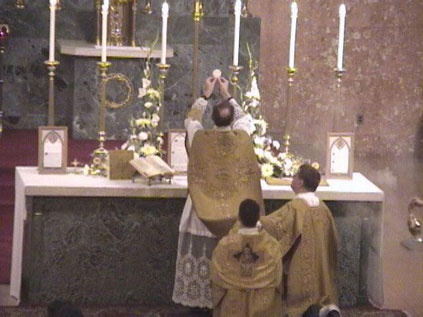
So now where are people who are interested in religion supposed to go, now that the Episcopal Church has gone further down the road to being a private, upscale community center? I saw where the Church was going years ago on a trip to Alaska to give a lecture and visit a theologian friend. She took me to the local Episcopal Church which had been colonized by academics and area yuppies--the tiny minority who were not yet resolutely secular. It was, I recall, an A-frame ski lodge affair in polished beech with a large hand-crafted patch quilt hanging from a balcony. The service consisted of selections of Good Music performed by the virtuoso organist, who taught at the university music department, and announcements of the various activities in which the congregation was engaged, including AIDS ministry, recycling and various social action projects. The liturgy was squeezed into the cracks of the corporate self-congratulation ceremony and there was, of course, the inevitable home-crafted bread baked by some organic housewife in birkenstocks.
But what are the alternatives? None for me because the split in the Church--not merely in the Anglican Church between Episcopalians and break-away groups, but between the old mainline and evangelicals across the board--mirrors the Culture Wars split in the larger society between secular liberals and religious conservatives. The difference is that within the larger society secular liberals are increasing while conservative evangelicals are declining, within the churches conservative evangelicals are taking increasing market share while the mainline is dying out. So the end toward this trend is heading will be the picture Obama's publicity crew has in mind when it tags yet another minority to be conciliated as "people of faith." The US, belatedly, will become a secular society on the European model, where most people are polite agnostics and where a small minority of polite conservatives, on the Rick Warren evangelical lite model, promotes family values.